The adrenal cortex is the outer portion of the adrenal gland and is responsible for secreting three main types of steroid hormones: mineralocorticoids, glucocorticoids, and androgens. These hormones are all synthesized from cholesterol and are essential for maintaining life-sustaining functions such as blood pressure, metabolism, and electrolyte balance. The cortex itself is organized into three distinct histological layers, each specializing in the production of a specific class of hormone.
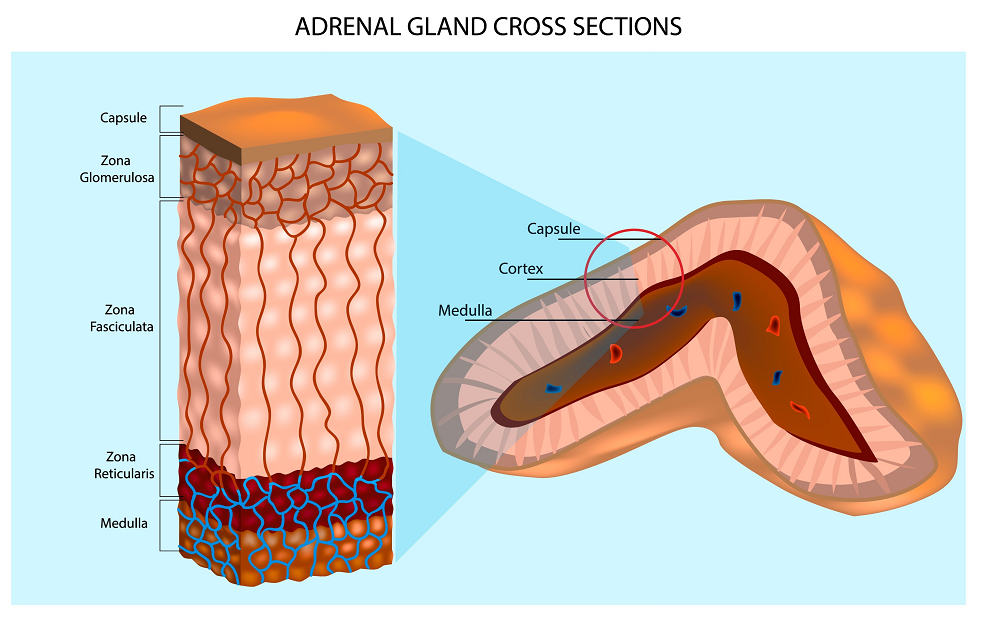
The outermost layer, the zona glomerulosa, secretes mineralocorticoids, primarily aldosterone. This hormone is critical for regulating salt and water balance in the body. It acts on the kidneys to promote the reabsorption of sodium and the excretion of potassium. By retaining sodium, the body also retains water, which increases blood volume and, subsequently, raises blood pressure. This process is primarily controlled by the renin-angiotensin-aldosterone system (RAAS) rather than signals from the brain.
The middle and largest layer, the zona fasciculata, produces glucocorticoids, the most significant of which is cortisol. Known as the “stress hormone,” cortisol helps the body respond to physical or emotional pressure by increasing blood sugar levels through the breakdown of fats and proteins. It also possesses potent anti-inflammatory properties and helps regulate the immune system. Finally, the innermost layer, the zona reticularis, secretes weak androgens like DHEA and androstenedione. These serve as precursors that are converted into more potent sex hormones, such as testosterone and estrogen, in other parts of the body, playing a role in the development of secondary sexual characteristics.
Frequently Asked Questions
What are the three distinct layers of the adrenal cortex?
The adrenal cortex is organized into three concentric zones, each responsible for producing specific hormones. The outermost layer is the zona glomerulosa, which consists of cells arranged in spherical clusters. This zone is primarily responsible for secreting mineralocorticoids, such as aldosterone.
The middle and largest layer is the zona fasciculata, characterized by cells arranged in long, straight cords (fascicles). This layer produces glucocorticoids, most notably cortisol. Finally, the innermost layer is the zona reticularis, which forms a branching network of cells adjacent to the adrenal medulla. This zone produces weak androgens, such as DHEA, which serve as precursors for sex hormones elsewhere in the body.
How does the adrenal cortex regulate blood pressure?
The adrenal cortex regulates blood pressure primarily through the hormone aldosterone, produced in the zona glomerulosa. Aldosterone acts on the kidneys to promote the reabsorption of sodium and water into the bloodstream while secreting potassium into the urine.
This process increases the total volume of fluid in the circulatory system, which directly raises blood pressure. The release of aldosterone is controlled by the renin-angiotensin-aldosterone system (RAAS), which is triggered when the kidneys detect low blood pressure or low sodium levels. Without a functioning adrenal cortex, the body cannot retain enough salt or water, leading to dangerously low blood pressure and cardiovascular collapse.
What is the role of cortisol in the human body?
Produced in the zona fasciculata, cortisol is often called the “stress hormone.” It helps the body respond to physical or emotional stress by mobilizing energy. It stimulates gluconeogenesis (the production of glucose from non-carbohydrate sources) in the liver, ensuring a steady supply of fuel for the brain and muscles.
Beyond energy, cortisol is a powerful anti-inflammatory agent that suppresses the immune system to prevent it from overreacting. It also helps maintain vascular tone, ensuring that blood vessels respond correctly to other hormones like adrenaline. Because it affects almost every organ system, maintaining balanced cortisol levels is vital for daily functioning and long-term health.
What are adrenal androgens and why are they important?
Adrenal androgens, such as dehydroepiandrosterone (DHEA) and androstenedione, are produced in the zona reticularis. While the primary sex hormones (estrogen and testosterone) are made in the ovaries and testes, the adrenal cortex provides a baseline supply of precursor hormones.
In males, these adrenal contributions are minor compared to testicular testosterone. However, in females, adrenal androgens are a significant source of testosterone, which is necessary for bone density, muscle mass, and libido. In children, the “awakening” of this zone (adrenarche) triggers the early signs of puberty, such as the growth of underarm and pubic hair, before the primary gonads fully mature.
What causes Addison’s disease?
Addison’s disease, or primary adrenal insufficiency, occurs when the adrenal cortex is damaged and cannot produce enough cortisol or aldosterone. The most common cause in developed countries is an autoimmune response, where the body’s immune system mistakenly attacks and destroys the cortical tissue.
Other causes include infections like tuberculosis, certain cancers, or genetic disorders. Because the cortex is responsible for salt balance and energy metabolism, patients with Addison’s disease experience extreme fatigue, weight loss, low blood pressure, and a characteristic darkening of the skin (hyperpigmentation). If left untreated, a minor illness or injury can trigger an “adrenal crisis,” which is a life-threatening medical emergency.
What is Cushing’s syndrome and how does it relate to the cortex?
Cushing’s syndrome is a condition caused by prolonged exposure to high levels of cortisol. This can happen if the adrenal cortex develops a tumor (adenoma) that pumps out cortisol uncontrollably, or if the pituitary gland sends too much ACTH (the signaling hormone) to the cortex.
The symptoms are striking and include weight gain in the torso, a “buffalo hump” behind the shoulders, and a rounded “moon face.” High cortisol also causes the skin to become thin and fragile, leading to purple stretch marks (striae) on the abdomen. Over time, it can lead to serious complications like Type 2 diabetes, high blood pressure, and osteoporosis due to cortisol’s effect on bone and sugar metabolism.
How does the brain control the adrenal cortex?
The adrenal cortex is controlled by the Hypothalamic-Pituitary-Adrenal (HPA) axis. When the brain perceives stress or detects low cortisol levels, the hypothalamus releases Corticotropin-Releasing Hormone (CRH). This signals the pituitary gland to release Adrenocorticotropic Hormone (ACTH) into the blood.
Once ACTH reaches the adrenal glands, it binds to receptors on the cortex—specifically in the zona fasciculata—to trigger the production and release of cortisol. To prevent levels from getting too high, the body uses a negative feedback loop: high levels of cortisol in the blood signal the brain to stop producing CRH and ACTH, effectively “turning off” the production line until it is needed again.
What is Congenital Adrenal Hyperplasia (CAH)?
Congenital Adrenal Hyperplasia (CAH) is a group of genetic disorders where the adrenal cortex lacks an essential enzyme (most commonly 21-hydroxylase) needed to make cortisol and aldosterone. Because the brain senses the low cortisol, it continuously pumps out ACTH to stimulate the gland.
Since the pathway to make cortisol is blocked, the “raw materials” in the gland are diverted into the androgen pathway. This results in the overproduction of male sex hormones. In female infants, this can lead to ambiguous genitalia at birth. In both sexes, it can cause “salt wasting” (dangerous loss of sodium) and rapid, early growth followed by short stature because the excess androgens cause bone growth plates to close too soon.
Can you live without an adrenal cortex?
No, the adrenal cortex is essential for life. While you can live without the adrenal medulla (which produces adrenaline) because the nervous system can compensate, the hormones of the cortex have no backup system.
Without aldosterone, the body would lose sodium and water so rapidly that blood pressure would plummet, leading to shock. Without cortisol, the body would be unable to maintain blood sugar levels or respond to any form of stress, even a common cold. Fortunately, if someone must have their adrenal glands removed (a bilateral adrenalectomy) due to cancer or severe disease, they can survive by taking daily hormone replacement therapy to mimic the natural output of the cortex.
How do doctors test the health of the adrenal cortex?
Testing often starts with blood, urine, or saliva samples to measure levels of cortisol and aldosterone. However, because hormone levels fluctuate throughout the day, a single snapshot is often not enough. Doctors frequently use stimulation or suppression tests.
In an ACTH stimulation test, a synthetic version of the pituitary hormone is injected to see if the adrenal cortex can respond by producing cortisol. If it doesn’t, it indicates adrenal insufficiency. Conversely, in a dexamethasone suppression test, a powerful synthetic steroid is given to see if the HPA axis “shuts down” properly; if cortisol stays high, it suggests Cushing’s syndrome. Imaging like CT or MRI scans may also be used to look for physical abnormalities or tumors.